
No one understands your applications and requirements better than you, but when looking for the right electrical wiring to suit your needs, it can be unclear what will fit (sometimes literally). We’re going to run through some common questions, explore wiring products used across industries and highlight what you should be looking for.
What is a wiring harness?
Essentially, a wiring harness is an organised group of wires that transmits electrical signals through a machine. It can be simple or complex, with as many wires, connectors and other types of components fitted into the harness as required. It is also known as a wiring loom or cable harness.
Usually a harness includes:
Wires or cables - a conductive metal core wrapped in an insulating material, usually plastic or rubber.
Wiring harness connectors or plugs - metal or plastic joined at the end of wires so that the harness can connect to another unit to transmit power or data through a whole system.
Protective coverings - rubber, plastic or fabric which is wrapped around the bundle of wires to keep them safe and together.
Fasteners - usually plastic cable ties designed to secure the group of wires in place.
Industry applications
Wiring harnesses are used in an extremely wide range of applications. Basically any machine or electronic device probably contains at least one wiring harness, even a tiny one. The most common uses for wiring harnesses are to transmit electrical current to systems inside of automotive vehicles (including boats and aeroplanes) and industrial machinery.
What’s the difference between a wiring harness and a cable assembly?
Cable assemblies tend to be one singular collection of wires, grouped together in a protective casing or sheath. Whereas a harness combines multiple bundles of wires connecting to various plugs or units, a cable assembly tends to be one small group of wires with a connector at one or both ends.
Wiring harnesses can be sprawling and complex, and are most often used internally. Cable assemblies are housed inside a heavy-duty covering, making them more suitable for harsher conditions or external uses.
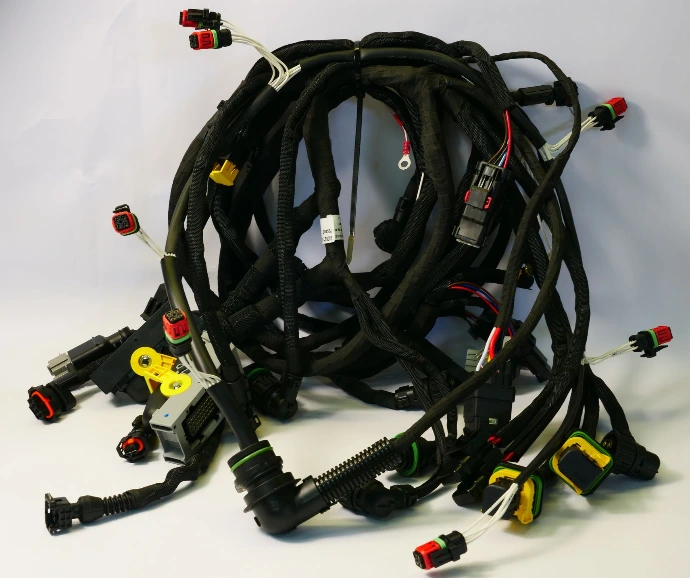
Example of a wiring harness
A large automotive wiring harness with multiple plugs and wiring systems overmoulded and covered in protective casings to maximise longevity.
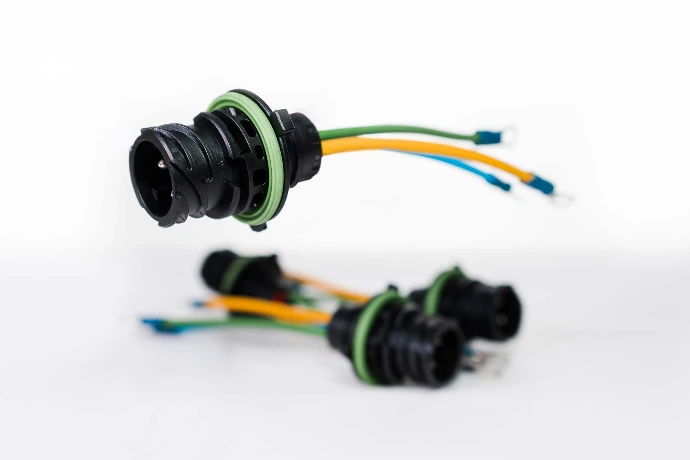
Example of a cable assembly
A simple cable assembly with an overmoulded connector on one end and terminals on the other.
Whether you require an assembly or a harness depends on what you need the wires to do and where they will be installed. We can work with you to ensure whatever system we design fits your exact requirements.
What makes a good wiring product: things to look out for
Secure, well-organised wires
The purpose of both a cable assembly and a wiring harness is to organise and protect wires. Keeping everything together helps ensure systems don’t take up too much space, will not be easily cut or damaged whilst in use and makes installation and fault-finding easier.
Your wiring products should be tightly and securely bound using the appropriate fasteners. It should be designed and crafted intelligently so wires are positioned correctly and fit optimally within the space that you have. It should be protected by the right coverings to maximise protection and longevity.
At Brucom, we have more than twenty years of experience crafting wiring harnesses and cable assemblies. We utilise fully or semi-automated methods to ensure all wiring products are reliable and well-built. We work with you from design to production, prototyping and testing to ensure we make the harness that fits and functions for you.
Materials suited to your needs
Your specific applications make a huge difference to how your wiring harness or cable assembly should be constructed. For example, in marine industries you need wiring and connectors that are protected from the damaging effects of salt water. In construction, you need a loom or assembly that can withstand intense use and corrosive materials like cement.
We’ve pioneered low-pressure, low-temperature overmoulding services to be able to mould harnesses and connectors into one singular, plastic-coated unit, sealing against the ingress of water, dust or any material.
-> Find out more about how overmoulding benefits you.
We can work with you to design the wiring harness that best fits your needs. With experience across marine, construction and the full range of commercial automotive industries, we know how to support you.
Wires thoroughly tested for function and quality
No matter how careful your design and building processes, the only way to know for sure if a wiring system works is to test it. Ensure your wiring harness and cable assembly manufacturer has thorough, effective testing processes that verify harnesses work.
We instigate roving inspections to continuously check work as we build it, plus in-depth testing of every harness and assembly before dispatch. We invest in the best testing machines and even have the tools to create our own testing jigs for really bespoke jobs. Find out more about our testing procedures here.
Modular systems that are easy to install and replace
A modular system is one that is built up of one or more easily replaceable and removable sections. Also known as a plug-and-play system, this design helps make harnesses and assemblies easier to install and replace should a fault occur.
We specialise in modular systems because we think they provide our customers with a range of benefits over a traditional wiring harness or cable assembly.
-> Find out more about the benefits of modular systems.
Wiring components
Maybe you need wires, but not a full wiring harness or assembly. Sometimes you need just one or two components for a project or repair. We stock and resell everything from wires and cables to terminals and splices. We carefully source materials to ensure that they are hard-wearing and fit for purpose. All of our components are high quality and cost-effective.
Explore our wiring products
Cable assemblies
Discover more about our cable assemblies or get in touch about your project.
Wiring components
Browse our stock of components including protective casings and connectors.